Cheeze Burger Font: Playful Display Type for Handmade Brands
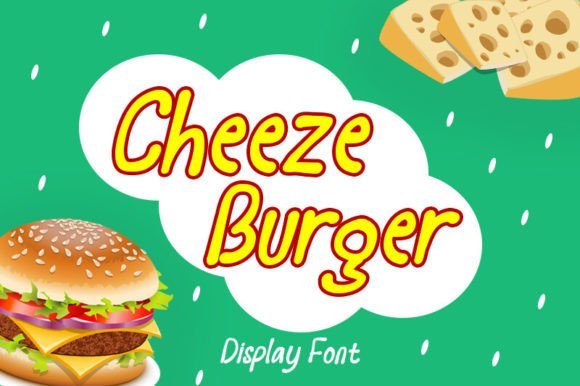
If you’ve ever spent hours tweaking a label, repositioning text on a printable planner page, or testing how a font cuts on your Cricut—only to realize it’s *almost* right but missing that spark—you’ll understand why Cheeze Burger landed in my cart and hasn’t left my active fonts folder since. It’s not just another display font. It’s a cheerful, confident, slightly cheeky typeface with rounded curves, friendly spacing, and an unmistakable handmade charm that reads as warm—not whimsical—and intentional—not childish.
Cheeze Burger shines brightest where personality meets practicality: product labels for small-batch candles, hand-poured soaps, or artisanal jams; die-cut stickers for planners and bullet journals; rustic wedding welcome signs; birthday party invitations that feel joyful without looking cluttered; and SVG designs for mugs, tote bags, and iron-on tees. Its bold, open letterforms hold up beautifully at sizes as small as 12pt on printed tags and scale effortlessly to 300pt for wall art or storefront signage.
What makes Cheeze Burger especially valuable for crafters is its balance of character and clarity. Unlike some playful display fonts that sacrifice legibility for flair, Cheeze Burger keeps counters open, stroke contrast gentle, and x-height generous—so “Honey Lavender” on a candle jar reads cleanly even under soft lighting, and “Happy Birthday!” on a foil-stamped card stays instantly scannable from across a room. I’ve used it for boutique gift tags (paired with a thin sans serif for ingredient lists), seasonal packaging for holiday cookie boxes, and even chalkboard-style café menus—always with consistent, positive customer feedback about the “friendly vibe” it brings.
For digital printables and templates, Cheeze Burger adds instant visual hierarchy. Use it for section headers on habit trackers, title blocks on recipe cards, or focal words in affirmation posters (“Breathe,” “Create,” “Grow”). Its rhythm invites attention without overwhelming—critical when customers are previewing your Etsy listing or scrolling through a Canva template gallery. And because it’s designed as a display font—not body text—it works exactly as intended: for short, high-impact phrases, names, titles, and decorative wording. Avoid using it for full paragraphs or fine-print instructions, but lean into it for anything meant to be seen, felt, and remembered.
Readability matters most when your font hits the cutting mat. Cheeze Burger cuts cleanly on both Cricut and Silhouette machines—no fragile serifs or tangled swashes to snag. I tested it on vinyl, heat-transfer material, and kraft paper sticker stock, and every version held crisp edges down to 0.25" height. For tiny stickers (think 0.75" round labels for mini jars), I stick to all-caps usage and avoid tight kerning adjustments—Cheeze Burger’s default spacing is already optimized for small-scale impact. When mocking up product previews, I always preview in RGB first (for screen use) and then convert to CMYK for print files—Cheeze Burger’s robust outlines translate smoothly across both color modes.
Font pairing is where Cheeze Burger truly sings. Try it with a relaxed script font—like a casual handwritten style—for greeting card headlines (“You’re Amazing!”) paired with elegant cursive subtext. Or pair it with a clean, neutral sans serif (think Montserrat Light or Inter Regular) for packaging: Cheeze Burger for the brand name, the sans for net weight, ingredients, and care instructions. For wedding stationery, I’ve matched it with a delicate serif (like Playfair Display Italic) for ceremony details—creating contrast that feels curated, not chaotic. The key is letting Cheeze Burger lead, then grounding it with something simple, structured, and highly legible.
Cheeze Burger comes as a single, well-hinted OTF file—no extra weights or italics, which keeps things refreshingly straightforward for crafters who need reliability over complexity. It includes standard Latin characters, numerals, and basic punctuation, making it ideal for English-language products, labels, and digital downloads sold globally. While it doesn’t include extended language support or stylistic alternates, that simplicity means faster loading in design software, fewer compatibility hiccups in Silhouette Studio or Cricut Design Space, and zero guesswork when prepping files for print-on-demand partners.
Licensing is non-negotiable—and this is where many crafters get tripped up. Cheeze Burger is a commercial font, meaning you’re fully cleared to use it in physical products you sell (mugs, shirts, tags), digital downloads (PDF planners, Canva templates), SVG bundles, client projects, and social media graphics. No hidden restrictions. Just make sure you’re using a legitimate copy purchased directly or from an authorized reseller—free font sites often lack proper commercial rights, and font infringement claims can shut down shops fast. When in doubt, check the license terms before uploading your first printable bundle to Etsy.
I keep Cheeze Burger in my “go-to display” folder—not because it’s flashy, but because it’s dependable. It makes a lavender soap bar feel special. It turns a simple “Thanks!” sticker into a moment of connection. It helps my brand feel human, approachable, and thoughtfully made. In a market crowded with generic fonts and AI-generated designs, Cheeze Burger is the kind of typeface that quietly says, “This was made with care”—and that’s worth more than any trend.